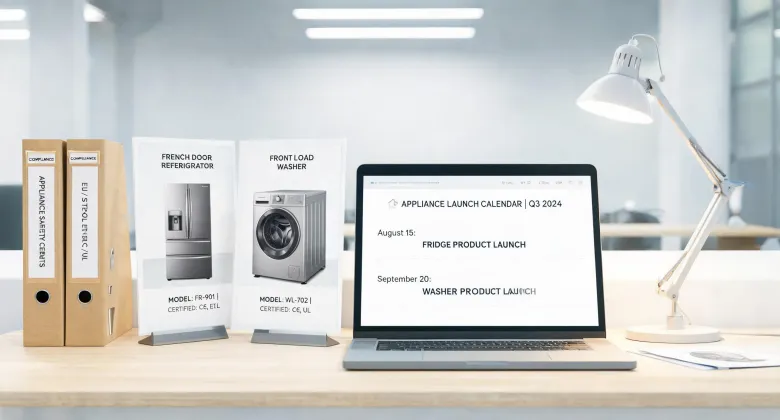
I work as a quality and brand compliance manager at Whirlpool. In practice, I review appliances before they're cleared for distribution—roughly 200+ units per year. I've signed off on models that now run in tens of thousands of kitchens and laundry rooms. I've also rejected units that didn't meet our specification. That experience changes how I answer a question I get constantly.
"Which Whirlpool product is the best?"
I get why people ask. But there isn't one universal best. There are scenarios, and a model that fits one setup can be the wrong fit for another.
Look, I'm not hiding behind "it depends." I evaluate equipment by scenario, and buyers should do the same. Here are three common situations:
- Scenario 1 — You're picking a refrigerator for a kitchen, apartment, or rental.
- Scenario 2 — You're choosing or maintaining a washer for a home, small property, or shared laundry room.
- Scenario 3 — You're adding cooling to a space with no ductwork, which is where the mini split AC system conversation comes in.
One of those probably matches what you're dealing with. Let's walk through each.
Scenario 1: You Need a Refrigerator
In our quality lab, we don't just look at whether a refrigerator reaches the right temperature. We check consistency, because a fridge that swings five degrees isn't doing its job even if the average number looks right.
Does a white Whirlpool refrigerator belong in that picture? Yes, for many installations. White is still a genuinely practical choice for rental kitchens, apartment buildings, and projects where budget matters. It costs less than stainless steel, it doesn't show fingerprints, and if a tenant scuffs the door, a white panel is easier to replace. The downside? White shows dust and grime more clearly in high-traffic areas. That's not a quality issue—it's a housekeeping reality.
Stainless looks better in a model unit or a hotel show kitchen. But here's a confession: it also shows fingerprints, and if you're doing frequent walkthroughs, you'll be wiping it down constantly. Neither finish is "better" from my side of the test bench. They fit different presentations.
One question that always comes up is: how long will eggs keep in the refrigerator? It's more relevant than it sounds, because it tests whether the fridge holds steady temperatures. In a Whirlpool refrigerator running between 37°F and 40°F, eggs stored on the main shelf stay fresh for about three to five weeks past the pack date. In the door? Door racks swing in temperature more. I've seen that easily knock a week off egg shelf life. If you want eggs to last, keep them on a middle shelf, not the door.
And one honest limitation: if your kitchen was designed for a counter-depth or built-in unit, a standard-depth refrigerator won't work—no matter how well it cools. That's a different product family, and I'll tell you that upfront.
Scenario 2: You Need a Washer—or Need to Keep One Going
When a dealer or property manager asks about the Whirlpool washer model WTW4816FW2, the first thing I look at is the platform. It's a top-load design with straightforward controls, and it handles normal daily family laundry well. For a single home or a small apartment, this is probably where I point you.
But if you're managing a laundry room that runs four or more loads per day, the scenario changes. That same top loader has a shorter service life under continuous commercial-style load. Commercial-grade front loaders are often a better fit because they spin faster, extract more water, and let people move through a wash cycle faster. Not because the top loader is a bad unit, but because it wasn't built for that workload.
Here's the other half of the washer conversation: maintenance. I'll be honest. For years I dismissed cleaning tablets for washing machine care as a selling gimmick. Then I reviewed service tickets from a property where 22 machines developed an odor. Nothing was broken. Detergent and softener buildup had created the kind of residue that leads to smells and eventually service calls.
What fixed it? A cleaning tablet run through a hot-water cycle with an empty drum. Once a month does the job for most units. If your washer is in a humid closet or gets heavy use, you may need it more often. And no, the tablet won't fix a failed pump or a worn bearing—those need a technician. But skipping the tablet isn't a cost-saving move. It's a future repair bill.
Sounds simple. Took me a while to learn.
Scenario 3: You're Thinking About a Mini Split AC System
Whirlpool's AC strength is in window and portable units. Ductless mini split systems are not where our lineup focuses. So I want to answer the mini split AC system question as plainly as possible, because I don't have a product to sell you in that category.
A ductless mini split is a genuinely strong option when you have a room with no existing ductwork. Think garage conversions, sunrooms, or an addition above a garage. It avoids the cost of installing new ducts, and it gives independent temperature control for that zone.
Where I hesitate is when someone proposes a mini split for a building that already has a functioning ducted system. That's often redundant, and each indoor unit adds its own filter and maintenance requirements. Also watch the cost of the refrigerant line run—in retrofit jobs, installation labor can become one of the largest line items. That's not a reason to avoid the technology. It's a reason to budget honestly.
If the room has no ducts and you want quiet, zoned cooling, a mini split is probably your best fit. If you already have central air, don't overcomplicate a working system.
If You're Still Unsure: Three Questions That Decide the Scenario
Not every purchase fits neatly into one bucket. A hotel owner might read Scenarios 1 and 2 because they're dealing with both kitchens and laundry rooms. A home builder might need all three. So here's the shortcut I use when someone asks for advice.
- What is the physical space? If it's a kitchen, start with refrigerator fit and finish. If it's a laundry room, count the expected loads per day. If it's an unconditioned space without ducts, cooling becomes the deciding factor.
- Who will maintain it? Rental and commercial setups need simpler controls and a predictable maintenance routine. In a home, the owner usually manages upkeep—so features and design carry more weight.
- What fails most visibly? If the refrigerator loses temperature, you throw away food. If the washer smells, guests complain. If the AC doesn't keep up, people are uncomfortable. Prioritize the appliance whose failure is most disruptive.
If you're in multiple scenarios, put them in order of daily dependence. That's your buying order.
Per FTC guidelines (ftc.gov), performance claims have to be truthful and substantiated with evidence. I keep proof records on every unit I approve. That's why this article doesn't give you "one best model." The best model is the one that fits your scenario—and now you know how to find it.